Related Posts Plugin for WordPress, Blogger...
Showing posts with label Bitcoin Magazine. Show all posts

Friday, 13 November 2020

Video: Bitcoin Eclipse Attacks And How To Solve For Them

https://ift.tt/3lwae9M

YouTube Video

Listen To This Episode:

In this episode of The Van Wirdum Sjorsnado, Aaron and Sjors discuss Eclipse attacks. More specifically, they discuss the 2015 paper “Eclipse Attacks on Bitcoin’s Peer-to-Peer Network,” written by Ethan Heilman, Alison Kendler, Aviv Zohar and Sharon Goldberg, from Boston University and Hebrew University/MSR Israel.

Eclipse attacks are a type of attack that isolates a Bitcoin node by occupying all of its connection slots to block the node from receiving any transactions, barring it from transactions other than those sent to it by the attacker. This would prevent the node from seeing what’s going on in the Bitcoin network, and potentially even trick the node into accepting an alternative (and thus invalid) version of the Bitcoin blockchain.

Aaron and Sjors explain how this type of attack could be used to dupe users and miners. They also discuss some of the solutions proposed in the paper to counter this type of attack, including solutions that have by now already been implemented in Bitcoin Core software. This includes a solution that will be included in the next Bitcoin Core software release, Bitcoin Core 0.21.0. They also mention one solution that is not included in the paper.

The post Video: Bitcoin Eclipse Attacks And How To Solve For Them appeared first on Bitcoin Magazine.


via Bitcoin Magazine https://bitcoinmagazine.com/articles/video-bitcoin-eclipse-attacks-and-how-to-solve-for-them?utm_source=rss&utm_medium=rss&utm_campaign=video-bitcoin-eclipse-attacks-and-how-to-solve-for-them

Multisig Coordination Software Nunchuk Releases Its Code

https://ift.tt/12L05rn

Recently-launched Bitcoin wallet Nunchuk announced today that it is making its application library, libnunchuk, open source and available to the public.

Nunchuk describes its mission as “the proliferation of multisig” and attempts to make multisig wallet security easier to achieve by offering a product that integrates some of the latest developments around partially-signed bitcoin transactions (PSBTs) and descriptor language.

“In the early days of Bitcoin, wallet vendors were often incompatible with one another, which complicated multisig setups,” according to an article from Nunchuk’s Hugo Nguyen. “Nunchuk treats descriptors and PSBTs as first-class citizens. The consequence is that you can use Nunchuk with many different hardware vendors, or easily recover a multisig wallet created by Nunchuk on other wallet software such as core.”

In an announcement about the code release shared with Bitcoin Magazine, Nunchuk explained that much of its library is built on Bitcoin Core, leveraging all of the robust advantages that this brings.

“Nunchuk’s architecture differs from other wallets’ for a number of reasons. But a major one is our decision to heavily reuse Bitcoin Core code,” according to the release. “The Nunchuk library creates a higher abstraction on top of Bitcoin Core’s inner building blocks, while reusing much of its logic such as: transaction and signature verification, PSBT, output descriptor and Branch-and-Bound coin selection algorithm.”

Additionally, the announcement indicated that the library offers hardware support, wallet management, encryption and minimal dependencies. 

“Nunchuk works out of the box with any server running Electrum protocol v1.4, including GetUmbrel, electra and ElectumX,” per the announcement. “TOR proxy can also be enabled for improved privacy.”

The post Multisig Coordination Software Nunchuk Releases Its Code appeared first on Bitcoin Magazine.


via Bitcoin Magazine https://bitcoinmagazine.com/articles/multisig-coordination-software-nunchuk-releases-its-code?utm_source=rss&utm_medium=rss&utm_campaign=multisig-coordination-software-nunchuk-releases-its-code

Bitcoin Cash Might Split Again This Weekend. This Is Why (And How)

https://ift.tt/12L05rn

Bitcoin Cash (BCH) might split again this weekend.

The Bitcoin ABC software client forked away from the Bitcoin protocol in mid-2017 to form a cryptocurrency of its own: Bitcoin Cash. Since then, Bitcoin Cash has deployed a backwards-incompatible hard fork upgrade every six months, requiring a network-wide upgrade across all Bitcoin Cash clients. While most of these upgrades have gone through relatively smoothly, a conflict within the Bitcoin Cash community in 2018 resulted in a split between Bitcoin Cash (the side that kept the original name) and Bitcoin SV.

Now, two years later (on November 15, 12:00 UTC, to be precise), another hard fork upgrade and another dispute within the Bitcoin Cash community could once again result in a coin-split.

What Is The Dispute? (And Between Who?)

At the heart of the dispute is an upgrade called the Infrastructure Funding Plan (IFP). The IFP would, as a protocol rule, enforce that 8 percent of every block reward — the coins earned by miners — is delegated to software projects working on Bitcoin Cash, like Bitcoin ABC.

According to the Bitcoin ABC team, the IFP — sometimes also referred to as the “miner tax” — would be designated through a new organization called the Global Network Council, consisting of major miners and holders of the cryptocurrency. The Global Network Council is scheduled to meet for the first time in January 2021, but beyond that, not very many specifics have been revealed about the selection of members or the procedure to distribute funds.

Bitcoin Cash Node — a software fork of Bitcoin ABC — is an initiative by various Bitcoin Cash developers and users who oppose the IFP, and have removed the upgrade from their source code.

There are a few different reasons the IFP is controversial. Some reject the upgrade on philosophical grounds, as they believe a “miner tax” is incompatible with Bitcoin Cash’s (or Bitcoin’s) philosophy and original design. If miners earn fewer coins when mining a block, this should also result in a decrease in hash power securing the network. Other concerns with the IFP include the lack of specifics regarding the distribution of funds, and they believe the setup may end up benefiting Bitcoin ABC more than other clients. Bitcoin ABC’s attempt to push the change through despite community opposition is also a concern in itself.

Does The Hard Fork Include Any Other Protocol Changes?

Yes, both Bitcoin ABC and Bitcoin Node will deploy a new difficulty adjustment algorithm.

New Bitcoin Cash blocks (like Bitcoin blocks) should be found about once every 10 minutes on average. However, due to Bitcoin Cash sharing a mining algorithm with Bitcoin, some Bitcoin miners occasionally switch to mining Bitcoin Cash when that blockchain is more profitable to mine. Because Bitcoin Cash usually has a mere fraction of Bitcoin’s hash power, such a switch results in big swings in the amount of hash power on Bitcoin Cash. This in turn results in periodic bursts where blocks are found much faster than once every 10 minutes, followed by a jump in difficulty. The switched miners then return to mining Bitcoin, leaving the original Bitcoin Cash miners behind on a chain that is now less profitable. Moreover, the sharp decrease in hash power tends to result in a much slower rate of block production. The hash power swings make the pace of transaction confirmation on Bitcoin Cash less reliable.

To help stabilize the pace of block production, the Bitcoin ABC team originally proposed a new difficulty adjustment algorithm called Grasberg. Grasberg would include an additional change however: block production would intentionally be slowed down for a few years to correct for “historical drift.” (For a couple of reasons, including a previous difficulty algorithm, Bitcoin Cash blocks have so far been mined faster than originally scheduled.)

The additional historic drift correction was controversial within the Bitcoin Cash community, however. This was, in fact, the original motivation behind the launch of Bitcoin Cash Node, which includes an alternative difficulty adjustment algorithm called ASERT. (ASERT is also new, though it predates Grasberg and was initially rejected by the Bitcoin ABC team.)

The Bitcoin ABC team eventually conceded to the implementation of ASERT, however, thus dropping Grasberg. This means that Bitcoin Cash ABC and Bitcoin Cash Node will be compatible — except for the IFP.

Why Has Bitcoin ABC Released Two Versions Of Its Software Client?

Late last week, Bitcoin ABC announced that it will in fact release two versions of Bitcoin ABC. One version of the software will enforce the IFP protocol rule as planned. Another version, however, will not, and will therefore be fully compatible with Bitcoin Cash Node.

The Bitcoin ABC team will only work to realize its development road map on the version of their software that enforces the IFP protocol rule, however. (This road map includes a flexible block size limit and decreasing the risk that unconfirmed transactions are double-spent, among other things.) The version without the IFP protocol rule will be minimally maintained to remain compatible with Bitcoin Cash Node, without further improvements.

Is A Coin-Split Guaranteed?

Not quite.

First of all, it’s worth noting that Bitcoin Cash clients (both Bitcoin ABC and Bitcoin Cash Node) are programmed to abort the current protocol, so a hard fork upgrade is more or less necessary. The current version of Bitcoin Cash will almost certainly not live on.

And obviously, if either Bitcoin ABC or Bitcoin Cash Node fails to attract enough hash power to produce a valid blockchain at all, there will be no coin-split. Only the version that attracts sufficient hash power would live on.

A coin split would in fact only happen if both the Bitcoin ABC and Bitcoin Cash Node sides attract enough hash power to produce a viable blockchain, as long as Bitcoin Cash Node attracts more than half of the total hash power between the two.

There is one other interesting scenario where a coin-split is avoided. If Bitcoin ABC attracts more than half of all hash power between the two (and maintains this majority), Bitcoin Cash Node clients would actually follow the Bitcoin ABC blockchain. This is because the new Bitcoin ABC software would be a soft fork in respect of Bitcoin Cash Node. Its protocol rules are the same, but with the IFP rule as an added restriction.

Put differently, Bitcoin Cash Node clients will accept it if a portion of the block reward is delegated to a Global Network Council (or to anyone else), they just won’t require that this happens. Blocks that don’t delegate the IFP funds would in this scenario be rejected by a majority of miners, and therefore not make it into the blockchain at all, ensuring compatibility.

(There are some more complicated scenarios, with new hard forks, that could also lead to a coin-split — but these are less likely and beyond the scope of this article.)

What Is Likely To Happen?

Currently, Bitcoin Cash Node has much more hash power support than Bitcoin ABC: more than 80 percent at the time of writing this article, versus less than 1 percent for Bitcoin ABC. Bitcoin Cash Node also appears to have significantly more community support, and large Bitcoin Cash-supporting companies like Coinbase, Kraken and BitGo have also indicated support for Bitcoin Cash Node. It therefore seems likely that (the name) Bitcoin Cash will live on through Bitcoin Cash Node and the compatible version of Bitcoin ABC.  (It would then probably also receive the “BCH” ticker on most exchanges, though some may opt for “BCHN” or another variant.)

Whether (the IFP version of) Bitcoin ABC will attract enough hash power to produce a viable blockchain remains to be seen. But if it does, it will have one strategic advantage over Bitcoin Cash Node. If it attracts more hash power than Bitcoin Cash Node, even after the split has occurred (but only up until ten blocks), the Bitcoin Cash Node blockchain would (in theory) “collapse,” and essentially disappear as Bitcoin Cash Node clients would accept the Bitcoin ABC blockchain instead. Any coins mined on the Bitcoin Cash Node blockchain, and any coins received on the Bitcoin Cash Node blockchain, would disappear with it. If Bitcoin ABC attracts enough hash power to even just make this a viable scenario, it might undermine trust in Bitcoin Cash Node, potentially only helping Bitcoin ABC further. (In practice, however, this unlikely scenario could itself be countered by the Bitcoin Cash Node scenario through another protocol upgrade.)

All things considered, however, it seems most likely that Bitcoin Cash Node will live on as “Bitcoin Cash,” and Bitcoin ABC will create a “new” cryptocurrency, most likely to also be called “Bitcoin ABC” (and probably with the ticker “BAB”).

I Hold BCH. Do I Need To Do Anything?

If you hold the private keys yourself, you don’t need to do anything. If a split happens, you will have access to both coins. (You might have to upgrade to new client/wallet software, depending on your client/wallet software.)

You might want to hold off from sending coins shortly before and after the hard fork happens, however. Because neither Bitcoin Cash ABC nor Bitcoin Cash Node implemented replay protection, sending one of the coins could accidentally result in sending the equivalent on the other blockchain. To be sure this doesn’t happen, wait until there is more clarity on this issue.

You might also want to hold off from receiving coins on the Bitcoin Cash Node blockchain. Although the risk seems slim, this blockchain could potentially “collapse” into the Bitcoin ABC blockchain if the latter attracts more hash power, and the coins you received will disappear with it. To be absolutely sure this doesn’t happen, wait until there is more clarity on this issue.

If you hold your coins on an exchange (or another custodial service) and a split occurs, the exchange determines whether you receive both coins, or one of them (and which one). Several exchanges have published announcements of their plans, with most supporting the Bitcoin Cash Node side of a potential split, or both. Ask your exchange for more information (or withdraw your coins before the split).

The post Bitcoin Cash Might Split Again This Weekend. This Is Why (And How) appeared first on Bitcoin Magazine.


via Bitcoin Magazine https://bitcoinmagazine.com/articles/bitcoin-cash-might-split-again-this-weekend-this-is-why-and-how?utm_source=rss&utm_medium=rss&utm_campaign=bitcoin-cash-might-split-again-this-weekend-this-is-why-and-how

Hodl Hodl Brings Non-Custodial, Bitcoin-Backed Lending Service To U.S.

https://ift.tt/12L05rn

Decentralized cryptocurrency exchange Hodl Hodl announced today that its lending service, Lend at Hodl Hodl, is now available to customers in the U.S.

“Lend at Hodl Hodl is a global, P2P, non-custodial, bitcoin-backed lending platform where anyone can lend or borrow stablecoins anonymously on a P2P basis,” per an announcement shared with Bitcoin Magazine.

The service allows users to create a lending contract and deposit bitcoin as collateral into its escrow directly from their wallet. The lender then transfers the loan amount outlined in the contract to the borrower and, once it is repaid, the lender releases bitcoin back to the borrower’s wallet.

As a decentralized exchange, Hodl Hodl acts more like a secure intermediary facilitating peer-to-peer (P2P) swaps between users. The Lend product is an extension of this non-custodial model.

“Unlike most existing lending platforms, Hodl Hodl does not store user’s funds, locking the collateral in the multisig escrow instead, with users holding the keys,” according to the announcement. “The platform has also eliminated the usage of fiat, to avoid any associated risks. The team believes that anonymity, no-custody and no-fiat makes it a true Bitcoin DeFi product.”

This is the first product that Hodl Hodl has extended to users in the U.S., according to the exchange.

“We have always wanted to serve U.S. customers, however some issues have tied our hands,” Max Kei, CEO of Hodl Hodl, said in the announcement. “Now, launching a Bitcoin DeFi product, we want to step beyond those issues. We see this project bringing value to the Bitcoiners all around the world, that’s why we are removing the borders. In the future, we aim to deliver more products to U.S. users.”

The post Hodl Hodl Brings Non-Custodial, Bitcoin-Backed Lending Service To U.S. appeared first on Bitcoin Magazine.


via Bitcoin Magazine https://bitcoinmagazine.com/articles/hodl-hodl-brings-non-custodial-bitcoin-backed-lending-service-to-u-s?utm_source=rss&utm_medium=rss&utm_campaign=hodl-hodl-brings-non-custodial-bitcoin-backed-lending-service-to-u-s

Thursday, 12 November 2020

As Governments Seek Encryption Backdoors, Bitcoin Becomes Critical

https://ift.tt/3pni3kG

YouTube Video

On November 6, 2020, the Council of the European Union released a “Draft Council Resolution on Encryption.” The document is supposed to serve as a precursor to a final text to be presented to the Council, on November 19 for potential legal adoption. It emphasizes support for data encryption in general, but also notes the challenges that encryption technologies pose for investigators who want to access criminals’ communications. 

“The European Union fully supports the development, implementation and use of strong encryption,” the report notes. “However, there are instances where encryption renders analysis of the content of communications in the framework of access to electronic evidence extremely challenging or practically impossible despite the fact that the access to such data would be lawful.”

It goes on to call for a “better balance” between communication encryption and lawful access of that communication, both ensuring the continued implementation of strong encryption technology while also ensuring that “competent authorities must be able to access data in a lawful and targeted manner.” 

This call for balance raised a red flag for privacy and encryption advocates around the world. Notably, a report from Austrian publication Radio FM4 falsely labeled this as an “EU ban on encryption” that included requiring platforms like WhatsApp and Signal to create master keys that would allow their end-to-end- (E2E) encrypted chats to be monitored.

Naturally, the privacy-focused Bitcoin community voiced concern about any resolution that would seek to weaken encryption. Though this particular draft resolution does not specifically call for encryption backdoors or loopholes, it offered a chance to consider regulators’ roles in pushing back on technology that allows unmonitored communications.

“There’s no such thing as a balance, you either have encryption or you don’t,” said Alex Galdstein, the chief strategy officer for the Human Rights Foundation, in an interview with Bitcoin Magazine. “So, we don’t want a balance. We want strong encryption. And when governments say that they want to balance, they’re acknowledging that they’re worried about people doing things with encryption that they can’t control.”

Despite the concerns that the idea of encryption backdoors from governments raise, in this case, Gladstein noted that we are “very far from an actual law being passed in the EU that would mandate some sort of forced backdoor into devices.” And, in general, the idea of establishing these backdoors would require cooperation from the tech industry implementing this encryption, which also appears unlikely.

“They want a software backdoor which I don’t think they’re going to get,” Gladstein said. “It’s not quite clear that tech companies are going to undermine their value propositions and openly give the government access to everybody’s messages… Even in the world’s most authoritarian places, tech companies want some sort of independence.”

Ultimately, this emphasizes the importance and power of technologies like Signal and Bitcoin. Governments can seek to mandate encryption backdoors or to collaborate with the technology creators, but without a private key they cannot access encrypted data.

“I think that we should be concerned about statements like this, but we should be confident that the technology can repel a lot of this,” explained Gladstein. “Bitcoin is … going to allow us to have this incredible tool that can really push back and allow us to have the digital cash that the cypherpunks dreamed of. And that can be a very powerful repellent against this increasing surveillance state.”

Gladstein encouraged those of us who can leverage encrypted technologies like Signal and Bitcoin to do so as much as possible, and to support the groups that make these technologies possible. While those living in democracies still have the chance to push back on draft resolutions, those living in regions that are ruled by dictatorships depend on these technologies as last resorts.

“I think we need to take advantage of some of the rights and liberties that we still have here in these domestic societies: make these companies push the technology as far as we can, put pressure on the courts, fund civil society organizations that will protect us, while knowing at the same time that most people on earth don’t have these privileges,” Gladstein said. “Their only hope is the technology. If you live in a dictatorship, your only hope is the tech.”

Listen To Bitcoin Magazine’s Interview With Alex Gladstein About The Importance Of Encryption In The Face Of Government Surveillance:

The post As Governments Seek Encryption Backdoors, Bitcoin Becomes Critical appeared first on Bitcoin Magazine.


via Bitcoin Magazine https://bitcoinmagazine.com/articles/as-governments-seek-encryption-backdoors-bitcoin-becomes-critical?utm_source=rss&utm_medium=rss&utm_campaign=as-governments-seek-encryption-backdoors-bitcoin-becomes-critical

Wednesday, 11 November 2020

Video: What Does The U.S. Election Mean For Bitcoin?

https://ift.tt/3eP8zd2

YouTube Video

Listen To This Episode:

Bitcoin has an unyielding apolitical nature which, oddly enough, makes it a political statement in today’s rampantly politicized world.

In this episode of Bitcoin Magazine’s Fed Watch, my co-host Christian Keroles and I discuss the recent U.S. Presidential Election and what it means for Bitcoin. Our discussion is wide-ranging, going from election irregularities, to the rebound in mining hash power, to bitcoin price predictions for the near term. Bitcoiners — those who believe that Bitcoin can change the world for the better — see bitcoin as generally insulated from most other market concerns. They think political and monetary events inevitably force the interaction of human nature with bitcoin’s unique properties creating a perhaps politically-unpopular yet unavoidable outcome. They believe this process will occur regardless of election outcomes and the only question is how fast it will happen.

I am a staunch anti-voting advocate who rips into elections as a route for central planners and statists to legitimize their infringement on the electorate. It is now popular to contest the validity of this election, and hopefully in doing so, people will realize that they should contest the validity of all elections. Casting a vote creates the very space for election fraud to exist and harmful laws to be enacted. We cannot achieve prosperity and happiness through a ballot box.

Nevertheless, markets seemed to approve of the outcome. Whether that is because they are trying to price in further stimulus or as an effect of relief that Election Day is over, markets leaped upward.

Keroles and I discuss where they are going from here. The conversation also moves toward the recent volatility of the Bitcoin hash rate. The last few weeks saw the end of the rainy season electricity rates in China and an apparent mass movement of mining equipment to other parts of the country. This resulted in the second largest downward adjustment in difficulty in the history of bitcoin mining, followed by a steep rebound. In this episode, I discuss at length from his recent article on the seasonal hash rate.

This is a guest post by Ansel Lindner. Opinions expressed are entirely his own and do not necessarily reflect those of BTC Inc or Bitcoin Magazine.

The post Video: What Does The U.S. Election Mean For Bitcoin? appeared first on Bitcoin Magazine.


via Bitcoin Magazine https://bitcoinmagazine.com/articles/video-what-does-the-u-s-election-mean-for-bitcoin?utm_source=rss&utm_medium=rss&utm_campaign=video-what-does-the-u-s-election-mean-for-bitcoin

Here’s A Chance To HODL 1 BTC With Bitcoin Black Friday

https://ift.tt/12L05rn

This is a promoted article provided by Bitcoin Black Friday.

  1. Join the waitlist for the Fold Bitcoin rewards card
  2. If you are already on the waitlist, refer friends to join

Bitcoin Black Friday has partnered with Fold to give away an entire bitcoin (yes, 100,000,000 sats) to one winner who opts into the Bitcoin circular economy between now and November 27 (Black Friday). 

To enter, customers simply need to join the waitlist for Fold’s much-anticipated Bitcoin rewards debit card and confirm their sign up with Carrot (you can find the waitlist by clicking on the promotional banner at BitcoinBlackFriday.com). As a company focused on putting bitcoin within reach of every shopper and building the circular economy, Fold is driving even more attention to Bitcoin-based commerce by minting one lucky winner as a sats hundred-millionaire in this unprecedented giveaway.

San Francisco-based Fold has an eye toward a world of hyperbitcoinization and is ushering in a new wave of Bitcoin users by building a payments stack for that new economy. Fold’s products are onramps for new Bitcoiners, facilitating the spending, earning and saving of bitcoin. Its newest product, the upcoming bitcoin rewards debit card, is a first of its kind, giving a percentage of purchases back in bitcoin to users every time the cards are swiped. For the debit card, Fold has partnered with Visa to offer rewards denominated in bitcoin instead of in points or airline miles, as with most other rewards cards.

“We’ve got a simple plan: Give away as much bitcoin as we can to as many people as possible in the shortest amount of time,” said Will Reeves, CEO of Fold. “We believe that Bitcoin is for everyone, and we’re building a product that makes it easy for everyone to accumulate it on everyday purchases. Many of our users are averaging 10 to 15 percent cashback in bitcoin on their purchases due to the appreciation in bitcoin’s price.”

Fold’s focus on building the bitcoin circular economy makes it the perfect partner for Bitcoin Black Friday, an annual event that has highlighted the growth of bitcoin commerce since 2012. Featuring deals from bitcoin-accepting merchants and from bitcoin product companies, Bitcoin Black Friday is a one-stop directory for Bitcoiners and those joining the bitcoin economy, giving them an easy way to save money and stack sats leading up to and on Black Friday (November 27) and Cyber Monday (November 30). 

With this partnership minting a new full-coiner, Fold and Bitcoin Black Friday are bringing attention to the onramps developing for bitcoin and adding growth to the bitcoin circular economy.

To become eligible for the 1 BTC giveaway, if you are not already on the Fold waitlist:

  1. Click on the promotion at Bitcoin Black Friday
  2. Join the waitlist for Fold’s new bitcoin rewards card 
  3. Confirm your sign up with Carrot

4. Stay tuned to Bitcoin Black Friday on November 27 when the winner is announced!

If you are already on the Fold Waitlist, you can also use your referral link to invite your friends to join the waitlist, and you will receive another entry in the Bitcoin giveaway for every referral that completes the process!

The post Here’s A Chance To HODL 1 BTC With Bitcoin Black Friday appeared first on Bitcoin Magazine.


via Bitcoin Magazine https://bitcoinmagazine.com/articles/heres-a-chance-to-hodl-1-btc-with-bitcoin-black-friday?utm_source=rss&utm_medium=rss&utm_campaign=heres-a-chance-to-hodl-1-btc-with-bitcoin-black-friday

Tuesday, 10 November 2020

Video: Bitcoin Is A Necessity, With Aleks Svetski

https://ift.tt/2UboqsS

YouTube Video

Listen To This Episode:

For this episode of the Bitcoin Magazine Podcast, host Christian Keroles sits down with founder of the Amber App and The Bitcoin Times Aleks Svetski to discuss his recent Bitcoin Magazine article “Because Bitcoin Is A Necessity, Its Economy Will Be Circular.”

This was a wide ranging conversation covering many of the first principle arguments for Bitcoin and sound money. As such, the resulting podcast and video are perfect to share with newcomers to the space, as it lays out the basic case for adopting BTC.

Find Svetski’s article here.

Topics discussed include:

  • How bitcoin is the perfect money in that it embodies all of the properties and functions that money should
  • How money is arguably the most important invention of mankind, and is the mechanism by which we measure time and energy and the communication medium through which we collaborate
  • Why major transformations like Bitcoin are progressions which diffuse through society in memetic fashion
  • Modern economics and fiat money
  • The issues with Modern Monetary Theory (MMT)
  • The local peaks and valleys for our money system
  • Why payments and financial privacy will not get better under the existing system and how they’re only going to get worse.

“When you look at modern economics and the fiat money it is dependent upon, you realize you can no longer accurately measure the product of your labor, preserve the product of your labor or freely and voluntarily exchange the product of your labor,” Svetski wrote in his article. “Payments and financial privacy will not get better under the existing system, they’re only going to get worse. Savings will not be protected under the existing regime, they will only deteriorate. The taxes demanded by and extorted from you by the growing public sector will not fall, they will only rise.”

The post Video: Bitcoin Is A Necessity, With Aleks Svetski appeared first on Bitcoin Magazine.


via Bitcoin Magazine https://bitcoinmagazine.com/articles/video-bitcoin-is-a-necessity-with-aleks-svetski?utm_source=rss&utm_medium=rss&utm_campaign=video-bitcoin-is-a-necessity-with-aleks-svetski

When Bitcoin Melts The System, Prosperity Steps In

https://ift.tt/3liDLnt

“Overcome by the giddiness that flying lent him, Icarus soared into the sky, but in the process, he came too close to the sun, which due to the heat melted the wax.”

The Legend Of Icarus
Jacob Peter Gowy‘s “The Flight of Icarus” (1635 to 1637).

Central banking, along with fractional reserve banking — two inseparable evils of monetary policies — have been distorting market price signals for the last 50 years. 

In 1971, the Nixon Shock corrupted the global monetary system by fracturing the final linkage between gold and the U.S. dollar. Fiat currencies were unleashed, issued and managed by central banks. Over the years, delusional interventionism enabled by politicized narratives to serve a middle class convinced into believing central manipulation is in their best interest, has brought fiat currencies’ purchasing power to its knees. 

Today, savers are penalized, while speculators and spenders are rewarded. This tendency to be punished by lowering one’s time preference feels alienating to many. It just doesn’t feel right. Yet, few are capable of putting a finger on why that is, including banking professionals and money managers whose salaries depend on not understanding it. 

With a dysfunctional monetary system that doesn’t hold value over time, many artificial distortions arise in all markets. Like a cancer metastasizing in its host, fiat currencies are the initial viral load that contaminated all territories governed by the fiat dogma, spreading the pandemic of central and fractional reserve banking.

A Misunderstood Sister

It is a well understood yet underappreciated fact that money accounts for 50 percent of the value of all transactions globally, and therefore a broken money can have severe repercussions, as it tricks every user into misleading economic calculus, ultimately leading to a distorted, apathetic and broken society. The logical construct behind the dissection of today’s evils is actually very simple: money is broken; fix the money, fix the world. 

Time is an invariably forward passage common to all humans, agnostic of status, wealth, ethnicity or location. We only have so much of it. Money is an instrument to store time for later use, ready for trade with other specialized individuals. With money acting as a neutral good for trade, everyone is more productive with their special craft — the beauty of the specialization of labor! All voluntary and peaceful human action that emerges as part of a free society is enabled by money, a neutral good for exchange within a capitalistic society, a system built on the ability to accumulate capital for later productive use and to do good around oneself. 

What happens if money decays faster than time, melting away the time people have accrued? How is the common man affected psychologically by a devaluing currency? How do assets behave when people store their savings using them to preserve their wealth? How are industries and markets structurally influenced when being close to money production is highly profitable? How will narratives around inflationary, “growth at all cost” compare to peaceful deflationary realities where individuals earn more by waiting patiently? What happens when sound money is finally restored to the people using free and open tools such as Bitcoin? 

In this brief exploration, we will raise fundamental questions around national monetary manipulation with fiat currencies, their effects on life, business and psychology and how a global monetary melting led by Bitcoin will drastically shift the world toward sustained deflation — the ultimate step toward unrestrained prosperity and abundance. Hop on! 

Saving Is Freedom

People save to plan for future uncertainty and enjoyment. A dad may want to save to feed his family tomorrow in case of an unplanned job loss, or to organize a family trip for the next holiday. A young person may want to save to build a business. Saving is the essence of all human life. It allows one to construct a well-balanced life. Without savings, a man is bound to get stuck on a never-ending hamster wheel, chasing his shadow. 

Savings are the root of all capital accumulation, that serve as the base of life and investing, which leads to productivity improvements, if done well. Doing more with less is great, and that’s what life is all about, starting with biological evolution. A more productive dad can spend more time with his kids and wife. A more productive fungus has more room to grow and take over a larger territory. That’s all pretty basic, yet fundamental. 

When money decays over time and fails to hold value, something odd happens. 

People feel the need to spend it quickly,  because they can get more with it immediately, compared to holding it for later use. Holding a devaluing money presents a penalty to a responsible saver. Better spend it and buy other goods and services, or invest it in yield-generating assets to preserve wealth over time (or to at least offset the inflation rate). 

The root problem lies in the forceful decision of spending, instead of voluntary saving. With monetary inflation, people will tend to buy things they don’t need and invest in stuff they don’t understand. The resulting artificial demand for goods and services is unnatural and triggers many ills such as asset and consumer price inflation. Industries end up being built by producers responding to these artificially stimulated price signals, which cause systemic malinvestment, the scale of which we have yet to fathom. 

Industries Built On Fiat Vice

Governments today measure economic development with a national metric called the GDP, which necessarily relies on consumption of goods as one of its primary drivers. Consumption means spending, which lowers savings, and, because saving is the basis of investing via gradual capital accumulation, it is easy to see how flawed a focus on GDP is. 

Two great evils have emerged from fiat currencies and government-led measurements of economic progress: consumerism and short-sighted financial engineering. 

Entire industries have been built on a delusional vision for mankind corrupted by debt-fuelled consumerism. Overzealous application of financial engineering is the atrocity pushing the boundaries of exuberance when it comes to enslaving our lives: buy things we don’t need (consume) with money we don’t have (debt). 

If people were consuming less because money was holding value over time, would advertisers spend around $700 billion per year to promote goods and services? Would social media platforms be tracking their users and manipulating individual views as much as they are to serve advertising giants? Would the world’s best software engineers spend their precious time architecting machine-learning models to optimize online ad spend? Would the smartest pool of talent spend outrageous hours in financial services, losing the most precious hours of their youth with little societal benefit to show for it?

Global banking is estimated to be worth roughly $5.3 trillion. As one of the most well-paying industries, banking and financial services are attracting millions of workers, accounting for around 23 percent of the total global workforce, including talented software engineers and developers with the ability to horizontally move to other industries. Creating a massive industry, the growth of banking is a direct result of the corrupted fiat currency system, which incentivizes the construction of ever more complicated financial engineering schemes. All this to protect wealth from centrally induced inflation deemed necessary by those who benefit from its existence, which for everyone else ultimately only serves to increase systemic risk until an eventual rupture leads to socialized losses — bail outs. 

Facebook, Google, YouTube and Amazon are advertising companies — under the semblance of speech-enhancing global social networks — receiving close to 40 percent of the global ad spend. Roughly $618.7 billion was spent by advertisers on these platforms last year alone, which incentivizes these companies to track their users as much as they possibly can to serve their paying customers: advertisers. Talented engineers are attracted to these companies, not to support free speech at a massive scale as social media could allow, but because the pays are indeed quite generous, with a median pay of a quarter million dollars at Google

In a sense, banking and advertising are truly important industries, which most definitely can add value to the world but have been corrupted by the evil of fiat monetary inflation, to the point that benevolence is no longer possible. Advertising and banking are dominating global economic activity, while they ought to be supporting well-functioning free markets. 

A Dark And Invisible Beast

First and foremost, monetary inflation is an expansion of the money supply. Monetary inflation renders all previously existing circulating units less valuable by diluting their presence in the total supply. 

Currency holders lose purchasing power due to inflation, which encourages them to get rid of it, as we just discussed, affecting many aspects of life such as time preference. Instant gratification feels good, and intrinsically, all biological organisms enjoy pleasure in the short term, knowing that long-term pain may occur as a result. Take a night out with friends drinking: sipping that extra glass of bourbon is undeniably enjoyable in the moment, but the next morning may not be so pleasant. 

Rationally, if someone knows that saving money for later use will render this money more valuable, the incentive to not spend it right away is strikingly obvious. What happens then? Demand for unnecessary items may contract as people reduce their spending. People may start thinking twice about their willingness to spend the money they earned with hard work. “Do I really want to buy the latest pair of Nikes or the newest iPhone?” This simple shift of mindset seems inconsequential at first, but it leads to a rippling societal change — a complete reversal of current norms plagued by over-consumption of frivolities. 

Allowing someone to reflect before making a decision to deny future wealth appreciation is a fundamental restructuring of the individual psyche. Delayed consumption lends space to think rationally, preventing superficial consumption. Instead of consuming life in the short term, one invests in their life for the long term. How does reliable and scarce money affect the human psyche? How does an individual change when exposed to delicate scarcity as opposed to extravagant abundance? What happens to a society protected by incorruptible assurances of sound money? 

A Reversal Of The Human Psyche

“A rolling stone gathers no moss.” Living a carefree life that is not built on solid foundations is unstable. Like a stone in the forest under the trees, the moss that accumulates is synonymous with a fresh and healthy environment, where time passes. A stone that tumbles in the river at the mercy of currents will not accumulate any moss — a torrential existence of misery. 

Individuals are no different. Stability and prosperity come from a foundation built on a secure shelter, a decent nutrition, a healthy lifestyle, a loving family, caring friends, incorruptible values and generous savings for cold rainy days. Not having that unshakeable foundation can lead to a life of misery with no meaningful accomplishment. 

All valuable things are scarce, and money is no different. Something abundantly available has little value. Water in an ocean doesn’t have much value, but in a deserted area, it can mean life or death. As individuals are exposed to truly scarce money, over-consumption stops. 

Today, this phenomenon is observed in reverse, fuelled by massive consumer and corporate debt levels, the polar opposite of low time preference. People are spending their future in the present by neglecting the burden of debt, and borrowing large sums of money to pay for items they cannot afford. 

Education in the U.S. is an obscene illustration of that for young adults, with 44 million students collectively owing $1.6 trillion of debt for their university degrees. American mortgage debt is nearing $10 trillion, which is propping up the real estate market in an unsustainable fashion. In total for the U.S. alone, consumer debt reached $14 trillion, while the corporate debt market hit $10.5 trillion earlier this year. Prior to the massive wave of stimulus led by governments all around the world, the sovereign debt market already hit an all-time high of $66 trillion, more than approximately 80 percent of global GDP. Overall, global debt-fuelled growth is a symptom of an illness in the money that we use globally, no different to the effect felt by individuals.

As mentioned earlier, a man with sound money lowers his time preference, facing the irrefutable scarcity of his storehold of wealth. As his savings appreciate in value over time, he can wonder about what he should be spending his time and money on next. He is now allowed to think before acting, instead of running on life’s proverbial treadmill. Getting rid of superfluous possessions is the number one priority. Leaving behind a life of frivolous spending hidden by the vicious ornament of “carpe diem,” this newly born man discovers the timeless prosperity of stoicism. Patience, devotion and loyalty suddenly emerge from the dust as strong values upon which he can build his reasoning. 

Learning to appreciate the beauty of things around him, this man’s heart fills with love and empathy for others around him who are still on the treadmill. Few things truly matter, and chief among those that do are his family, his health and his life’s work to make things better around him. Sound money changed him. A fast life of abundance filled with comfort and certainty now feels shallow and miserable. Progress made through work, pain and love allows him to tackle uncertainty and find stability in the chaos of life. As he delays his own gratification to plan for his family or entrepreneurial venture, he reduces his consumption, accumulating liquid reserves. Savings allow him to be free, and because they are appreciating in purchasing power over time, the more patient he is, the more reward he inevitably reaps. 

What happens if this effect on the individual spreads to society? As people demand less of products and services under a bitcoin standard, but also reduce their speculation in asset classes to preserve their wealth, a global deflation flourishes, allowing individuals and families to attain increasing purchasing power, further driving society toward prosperity.  

A Global Delflationary Repricing 

When consumer behavior shifts, producers undoubtedly adapt their output to meet the new demand. If there is a demand shock, prices will plummet until buyers are found, such that producers can distribute their past production, and re-adjust their upcoming production cycle to meet lower demand levels. Producing less, entrepreneurs and organizations can focus on quality over volume, which should create more value for the buyers, perhaps willing to pay more for the products and services they are receiving, bringing prices back to an equilibrium. 

In a society with sound money, where monetary production is locked away from the greedy minds of faillible humans, such as is the case with bitcoin, consumption slows down. As mentioned, faced with inalterable scarcity, individuals understand the cost of instant gratification. Suddenly, frivolous spending seizes to be common, because it ends up being so costly in the future. When cash reserves appreciate over time, products and services become more affordable, and individuals along with businesses end up spending later to enjoy a higher purchasing power. 

Inflation may turn negative. Many investment strategies built on the mandate to preserve wealth and capital for the long term may turn obsolete as a result. Positive real returns today represent a key driver for long-term portfolio managers who are mandated to protect capital from inflation erosion over multiple decades. What happens when inflation turns negative? In such a scenario, cash doesn’t lose purchasing power. The well-known “cash is trash,” popularized by hedge fund superstar Ray Dalio, becomes a slogan of the past. Suddenly cash is restored with a fundamentally important property of sound money: a lasting storehold of wealth.

In a sound money society, cash is not only the most liquid saleable asset acting as a medium of exchange and measure of value, but it acts as a store of value. Anyone willing to solely preserve wealth over time and have access to liquidity to meet short- and medium-term obligations only has to hold cash. For trillions of dollars of capital parked in assets to preserve wealth over time, this represents a drastic shift. Bitcoin is the instrument which may turn the world upside down, reversing investment strategies for many asset managers across the world. 

As Bitcoin maintains a steady cadence in its process of monetization, it will continue to absorb a material amount of wealth from the fiat legacy paradigm, plagued with inflation and currency debasement, until total collapse. Some would argue that such a particular view is extreme, while others would maintain that it is absurd and ignorant not to hold it. As this process proceeds and bitcoin attains unfathomable levels of market value, asset classes such as real estate, gold and equities will be repriced. Fundamental valuation models for the classes of assets exist today, and are well understood. Undeniably, today, most of these asset classes are deemed to be overpriced by multiple investment managers looking to find value in underpriced assets. Truth be told, most of these assets have accrued a monetary premium, which emanates from their respective utility as decent storeholds of wealth. 

An asset that is understood by the market as a viable store of value is relatively scarce compared to the currency from which the saver is trying to find protection, while also being quite durable over time. Real estate is an asset class estimated to be worth $280 trillion and owes a material amount of this aggregate market valuation to the storehold of wealth use case. Indeed, many investors are parking capital in buildings of popular capital cities to preserve their wealth, often leaving their units vacant, as is the case in Vancouver. In other words, the utility of real estate, as a good for shelter, is not leveraged in this scenario, but only in the fact that urban properties are relatively scarce and durable in politically stable jurisdictions. 

Equities behave according to the same principles. As a market of roughly $90 trillion today, they are mostly well understood with valuation models such as price-to-earnings ratios. Generally speaking, over a certain threshold, based on the industry and other factors, a company will be deemed overpriced or undervalued. Most equities today are used in diversified, 60/40 portfolio allocation strategies to preserve wealth against the erosion of fiat. Fixed income markets are another massive segment used for wealth preservation, especially T-Bills which are deemed “risk free” by some market participants. 

What happens when investors withdraw from these asset classes to hold wealth-preserving cash? Most likely, a massive burst will follow. The monetary premium accrued over years of weak fiat currencies will be shifted back by a sound money standard, pushing investors outside of risk-on positions to preserve wealth. Investment will be made to derive a return on capital, not only to beat inflation from fiat currencies. 

In its early phase of monetization, Bitcoin as the global monetary base may capture significant portions of the aggregated monetary premium accrued by different asset classes over the last decades of fiat currency experimentation. As these asset classes are repriced by markets, free of artificial fiat monetary inflation, purchasing power will be restored to the people.   

One may wonder how long it may take for bitcoin to become the world’s dominant numeraire — the underlying unit of measurement of value that we collectively use to price assets and consumer goods. How much will markets such as real estate, stocks and gold shrink by, if Bitcoin absorbs their cumulative monetary premiums? How will consumption patterns change for individuals and businesses evolving under a deflationary Bitcoin standard? How will humans refocus their time and energy if massive industries such as advertising and financial services are reduced by 30 percent? What about 70 percent? Will humans get to Mars much quicker if the best talent can focus on rocket engineering instead of ads optimization? 

All these are fascinating questions that we may attempt to answer another time.

The post When Bitcoin Melts The System, Prosperity Steps In appeared first on Bitcoin Magazine.


via Bitcoin Magazine https://bitcoinmagazine.com/articles/when-bitcoin-melts-the-system-prosperity-steps-in?utm_source=rss&utm_medium=rss&utm_campaign=when-bitcoin-melts-the-system-prosperity-steps-in

Video: Valiu And Protecting Wealth In South America

https://ift.tt/3liDEs3

YouTube Video

Listen To This Episode:

On this episode of the Bitcoin Magazine Podcast, host Christian Keroles sits down with Simon Chamorro to discuss Valiu, a tool for protecting Colombian pesos from inflation and remit funds to friends and family in Venezuela, which has been hit heavily by hyperinflation.

On its website, Valiu is described as a way to protect your money from inflation using synthetic “valiu dollars”:

“Top up Valiu dollars using Colombian pesos. Save your Valiu dollars or transfer them to your friends and family in Venezuela instantly and for free,” per the site. “Send money instantly to other Valiu users, or in an hour to a bank account in Venezuela. You can pay directly through any of our partners.”

Due to government mismanagement and other factors outside of their control, Venezuelans have seen their fiat currency’s value tumble, leaving it all but unusable for daily commerce and eradicating any savings that most people held. Bitcoiners point to these events as evidence of flaws inherent in the legacy financial system that would be remedied by a fixed-supply, third-party-free, deflationary form of sound money like bitcoin. As such, Valiu and Bitcoin are both tools that enable wealth protection for citizens of countries like Venezuela, providing alternatives where there were none before.

Chamorro discusses how his platform navigates regulation and how the Valiu team approaches user experience. Finally, he discusses the financial issues in South America and how both Bitcoin and synthetic dollars are helping.

The post Video: Valiu And Protecting Wealth In South America appeared first on Bitcoin Magazine.


via Bitcoin Magazine https://bitcoinmagazine.com/articles/video-valiu-and-protecting-wealth-in-south-america?utm_source=rss&utm_medium=rss&utm_campaign=video-valiu-and-protecting-wealth-in-south-america

Monday, 9 November 2020

New North American Mining Pool Bets On Region And Regulatory Compliance

https://ift.tt/12L05rn

North American bitcoin mining farms all use mining pools to ensure steady block rewards, compiling hash power from miners operating remotely to compete with the industrialized farms based in China. Most of these mining farms use China-based mining pools (pools whose headquarters and, perhaps, servers for collecting hash power, are located in China) because the fees that they charge for collecting and distributing hash power are the lowest in the world. 

However, the days of unregulated mining pools serving the North American market may be ending. And hoping to fill that potential void is DMG, a diversified mining services business headquartered in Vancouver that is opening a new pool for North American miners emphasizing full compliance with all regulations.

The Mining Landscape Today

Bitcoin mining in North America got a shot in the arm recently caused by a dramatic drop in difficulty rate as the rainy season in China’s Sichuan province ended and miners went offline.

In a recent newsletter, Bitcoin media company HASHR8 described the change: 

“… huge amounts of hashrate is coming offline due to the end of rainy season in Sichuan. That means miners are enjoying both greater revenue and will have a significant reduction in their input costs once the difficulty level adjusts to represent the hashrate drop.”

A recent report based on BTC.com data noted that this drop in mining difficulty includes the largest percentage drop (at 16 percent) since the first miners with ASICs were brought online in 2012.

The HASHR8 report also noted that, thanks to this drop and recent bitcoin price increases, miners are entering “an extremely lucrative” mining period. This would be the continuation of a trend, as Coinmetrics reported that in October, bitcoin miners generated an estimated $353 million in revenue, up 8 percent from the month before.

DMG Sees A Golden Opportunity In Compliance

With the landscape this ripe for lucrative mining, Vancouver-based blockchain company DMG has announced its new mining pool, Blockseer, which is “dedicated to transparency and good governance” for the North American market.

In its announcement, DMG added:

“Blockseer’s new Bitcoin mining pool will be North America’s first bitcoin mining pool that will not only meet, but exceed the U.S. Government’s Office of Foreign Assets Control (OFAC) compliance for BTC addresses, as well as providing the utmost level of transparency, auditability and corporate governance.”

Sheldon Bennett, COO of DMG Blockchain Solutions, told Bitcoin Magazine that the firm knows it is competing against Chinese pools that can offer lower fees for its member miners.

“We are not trying to compete on price,” he explained. “Instead we are providing better value to companies that care about fair billing and clean mining blocks (i.e., not supporting crime by putting known nefarious transactions in a block our pool mines).”

Bennett added that farms will be willing to pay a premium for compliance.

“We feel that companies will be willing to pay standard mining pool fees (i.e., 2 percent) for full transparency and ensuring their servers/miners are not involved in adding North Korean or Iranian or other blacklisted wallets from OFAC in moving Bitcoin.” he said.

DMG is fully regulated as a public company listed on the TSX Venture exchange meaning it must follow all relevant regulations, including independent third party audits, IT audit standards and internal controls.

Ethan Vera, cofounder and CFO of Seattle-based mining software provider Luxor, which currently operates the only mining pool based in North America, sees big changes coming to the North American mining landscape, which will ultimately require the presence of regulation-compliant pools.

“I believe we will start to see a change here for a few reasons; miners are becoming more institutional and require a compliant hash rate counterparty, profit-switching could allow North American pools to become more profitable for miners and mining pools will get further integrated into larger products offerings like ASIC financing, exchanges or hosting services,” he told Bitcoin Magazine. “The benefits of working with a U.S.-based mining pool is that you can form a contract with a company operating in the same legal jurisdiction with real recourse in the case that something arises.”

Ryan Porter, head of business development for BitOoda and a keen observer of the North American crypto scene, also sees a growing acceptance among miners that some regulatory compliance may be necessary going forward.

“In terms of the differences between off-shore and North America, I think what we’ve seen lately with the U.S. regulators action against BitMEX for not having anti-money laundering (AML) and know your customer (KYC) policies could serve as an indication of the issues in using offshore service providers,” Porter told Bitcoin Magazine. “It’s my view that there will be a demographic of miners here in North America that will opt to use a mining pool that checks those regulatory boxes.”

Despite the difficulty in competing with the fees offered by China-based mining pools, Porter is not surprised by DMGs venture into the space.

“Mining pool companies are needing to find new ways to differentiate themselves to attract new business rather than just competing on fees,” he explained. 

The Long Road Ahead

Still, DMG will face a long road in benefitting from a fundamental change to the way that mining farms have selected pools up to this point. U.S. and Canadian mining farms usually choose to sign up with pools in China which offer the lowest fees.

“The reality is that the majority of miners are agnostic,” John Lee Quigley, head of research for HASHR8, told Bitcoin Magazine. “A consideration like the location of the mining pool is low in the pecking order of priorities. Most miners will make their decision based on factors directly relating to profit margins. Factors like fees, add-on services, and industry connections are much more important to miners [than transparent regulatory compliance].”

In his interview with BItcoin Magazine, Vera echoed that standpoint.

“The majority of new miners in North America continue to join the large mining pools in China,” he said. “In most cases, profitability triumphs over all other considerations, and the Chinese pools have historically offered the lowest fees.”

And even if mining farms defect from China-based pools, DMG won’t be the only North American option available. An industry insider told Bitcoin Magazine confidentially that more mining pools will soon be announcing North American operations.

“As more Northern American miners accumulate hashrate in 2020 and 2010, I would not be surprised to see new North American mining pools established to target this growing market,” Thomas Heller, the COO of HASHR8, said in a conversation with Bitcoin Magazine.

At one of the most interesting junctures in the history of Bitcoin mining, a significant change to the distribution of mining pool operations appears imminent. Whether farms are willing to concede lower fees in exchange for regulatory compliance is an open question, but one that DMG could soon answer.

The post New North American Mining Pool Bets On Region And Regulatory Compliance appeared first on Bitcoin Magazine.


via Bitcoin Magazine https://bitcoinmagazine.com/articles/new-north-american-mining-pool-bets-on-region-and-regulatory-compliance?utm_source=rss&utm_medium=rss&utm_campaign=new-north-american-mining-pool-bets-on-region-and-regulatory-compliance

Don’t Fall For The Biggest Mistake In Bitcoin

https://ift.tt/12L05rn

Bitcoin is highly technically-secure as a protocol, meaning that there is only one reason why you’d ever lose your coins: human error. As with many things, people are the biggest security vulnerability in Bitcoin and, as we know, humans are far harder to fix than code.

Two stories from last month showed how far we are from solving Bitcoin’s security challenge. At the beginning of October, federal prosecutors charged crypto trading platform BitMEX with facilitating unregistered trading violations. Two weeks later, one of the world’s largest crypto-fiat exchanges suspended withdrawals indefinitely after one of its key holders went AWOL. 

As Noelle Acheson pointed out, these stories highlight one of the biggest ironies of the cryptocurrency market, which is that an industry born on the basis of decentralization is dominated by centralized businesses with centralized vulnerabilities.

Somewhere along the line, Bitcoin’s defining ethos of decentralization has been forgotten. Not by everyone, it’s true; but by a large proportion of both new and experienced Bitcoiners who continue to naively believe that their bitcoin is safer when someone else holds the keys.

On-Exchange Is Insecure 

Let’s be clear: without exchanges, there would be no Bitcoin ecosystem. Period. The problem

isn’t with these platforms per se but with the assumption that an exchange is the safest place to store bitcoin. 

It’s easy to see how this happens. People make the mistake of assuming that bitcoin functions just like cash, and that coins are best protected by handing them over to a third party which can leverage enterprise-grade security technologies to ensure that they are best protected. But there’s a crucial difference between bitcoin and traditional forms of money: unlike cash, you never “hold” bitcoin; you only own the keys that control them on the blockchain. 

To read more about how bitcoin keys are secured by the individuals who own them visit our guide on bitcoin wallets.

Bitcoiners who don’t realize this can in turn believe that they are putting their coins into a digital Fort Knox, but all they have actually done is cede all control (and therefore ownership) of their bitcoin to a third party. And if the bitcoin is mismanaged and lost by that third part, it’s likely that it will never be recovered. The only way to ensure that your bitcoin is highly secure is to self custody your keys in a cold-storage wallet. 

So, what’s gone wrong? Why is this message not filtering through to more Bitcoiners? And why aren’t exchanges educating their customers on best practices for keeping their coins secure?

The most obvious answer is that it suits exchanges to keep hold of their customers’ Bitcoin keys since this makes it easier for people to actively trade. There are other, less savory reasons why an exchange might want to keep control over the keys that secure bitcoin, but overwhelmingly, the main motivation is to make the whole process of buying, trading and storing bitcoin as seamless as possible. But if they comes at the cost of making Bitcoin significantly less secure, all these advantages count for nothing. 

Putting Security In Users’ Hands

Bitcoin has transformed the world so quickly that it’s easy to forget how recently it was introduced. In seeking to improve user education, we have to remember that it takes ordinary people time to grasp any new infosecurity concept. Self-custody is no exception.  

It certainly hasn’t helped matters that our industry has, wherever possible, appropriated language and concepts associated with fiat cash, which provide poor analogies for explaining an entirely new concept of money. After all, bitcoin wallets don’t contain any bitcoin in the way that regular wallets contain fiat: they hold your keys. We need to educate people so that they would no more trust a stranger with their crypto keys than they would with their house keys. 

Fortunately, it looks like people are beginning to get the message. Since March 2020, the value

 of bitcoin held on-exchange has fallen by about 10 percent or $2.85 billion following high-profile hacks at exchanges and trading platforms including KuCoin, Eterbase, Cashaa and many others.

Even though hackers weren’t to blame for the debacles at BitMEX and OKEx, they still served to highlight how vulnerable your coins are when you don’t self-custody the keys. 

In view of these repeated coin catastrophes, it’s difficult to see how exchanges and other Bitcoin platforms can continue to ignore user education. And since anything that harms adoption or damages consumer trust is bad for everyone in the wider Bitcoin ecosystem, I believe that this effort is everybody’s business.

In all fairness, there are exchanges that do a really good job at promoting self-custody

 to their customers, with Kraken being just one example. But this commitment to user education must become the rule, rather than the exception.

Remember that Bitcoin was never meant to be merely a competitor to fiat currency, but a revolution in our very relationship with money. If we want people to embrace the ethos of decentralization that enables anyone to be their own bank, let’s help them avoid the biggest mistake they can make, and instead ensure they take full responsibility for securing their Bitcoin.

This is a guest post by Ron Stoner. Opinions expressed are entirely his own and do not necessarily reflect those of BTC Inc or Bitcoin Magazine.

The post Don’t Fall For The Biggest Mistake In Bitcoin appeared first on Bitcoin Magazine.


via Bitcoin Magazine https://bitcoinmagazine.com/articles/dont-fall-for-the-biggest-mistake-in-bitcoin?utm_source=rss&utm_medium=rss&utm_campaign=dont-fall-for-the-biggest-mistake-in-bitcoin

Friday, 6 November 2020

Following One Decade Of Growth, DeFi Could Guide Bitcoin’s Next

https://ift.tt/3k3EKXi

Since 2009, Bitcoin has come a long way while proving its worth, improving its regulatory standing and raising interest globally through media and the internet. From having zero relative value to fiat as a currency in its early days to being valued at $19,783.06 in December 2017, bitcoin has shown immense power. Today, nearly everybody, whether or not they know about blockchain technology, has at least heard of Bitcoin. 

Below is a timeline meant to express how far Bitcoin has come in such a relatively short amount of time, from inception as a revolutionary concept to an asset that is being hoarded by major, publicly-traded companies. It has faced various kinds of uplifts and downfalls and has stood strong through all of them. Let’s look into how well Bitcoin has performed in the last decade and the new trend in the space that could bring it even further along.

Bitcoin’s Journey So Far

Bitcoin came into existence in 2008 when, for the first time ever, a real-life cryptocurrency was introduced. Bitcoin’s white paper was released by Satoshi Nakamoto as “Bitcoin: A Peer-to-Peer Electronic Cash System” while Nakamoto’s identity has remained a mystery since. It was launched to ensure a decentralized peer-to-peer currency trading and exchange system in which no third party is involved to delay the transaction process and charge additional money for allowing transactions.

But Bitcoin, more than any other cryptocurrency project, has become a tool for all genders, nations and races alike — marked by the highest market capitalization of any cryptocurrency by far. The number of daily Bitcoin transactions have been increasing, from around 201,600 transactions per day in 2016 to approximately 381,650 transactions per day in 2019.

As the world’s most versatile cryptocurrency, bitcoin has been used to purchase goods and services, or as an investment asset and as a tool for achieving sovereignty. It is easily exchangeable for other cryptocurrencies or other fiat currencies through various exchanges. Before Bitcoin came into existence, a number of digital cash technologies prevailed, but each had its limitations and included third-party systems. Bitcoin came as a revolution that went beyond these electronic cash systems. 

Bitcoin has impacted almost all the fields of life, particularly the economic, banking and financial sectors. Each transaction made on the Bitcoin blockchain is digitally recorded to ensure high security along with high speed. Although all transactional information is shared among all the nodes in the network, the transacting individuals’ identity is kept secret and is never revealed. The financial and economical power which was once solely owned by the governments and the central financial institutes has been revolutionized thanks to the invasion of Bitcoin along with blockchain technology, which make these institutes wary of this trailblazing technologies.

Bitcoin’s Journey As An Asset Today And Into The Future

Throughout the past decade, there has been constant fluctuation in bitcoin’s financial value relative to fiat currency.

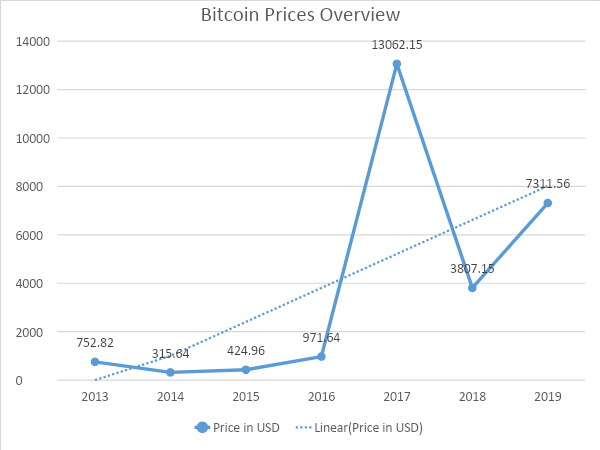
But overall from 2013 to 2019, bitcoin has maintained its integrity. Bitcoin trade took off in 2013 when it was valued at $13.50 in the beginning of the year, before hitting $220 in early April, then settling down at $70 by the end of April of that year. 

The graph below shows how volatile Bitcoin’s prices was between 2013 and 2019:

Source: year-end data from CoinDesk

Today, bitcoin is being recognized as a currency, more than just as an investment asset. Bitcoin is openly accepted in most developed and developing countries around the world. There have been 583.532 million BTC transactions so far in 2020 alone (as of this writing on November 5, 2020)

For much of 2020, bitcoin maintained a price range below $10,000 with a lowest value of $5,000 in its first half. As of November 3, 2020, bitcoin is valued at $13,731. Bitcoin prices are as unpredictable as the weather but we can anticipate steady growth in its value till the end of 2020. I expect Bitcoin to hit all-time high rates by the end of 2020, due in part to the new trends emerging in decentralized finance (DeFi).

As of this writing, a total of 18.534 million BTC are currently in circulation, but only about 169,200 BTC are locked into other DeFi projects through “wrapped” bitcoin projects that lock the asset onto other blockchains.

As per these stats, less than 1 percent of all BTC in circulation are now locked into other DeFi projects. But as DeFi experiments attract more public interest, gain more trust and lock in more bitcoin, bitcoin’s value and utility will elevate.

Bitcoin is still loyal to its aim of freeing people to transact on their own terms while ensuring security and anonymity at the same time. Bitcoin has improved enormously in its financial and technical aspects throughout the last decade and yet has a long way to go. As soon as Bitcoin clears its way through tax liabilities, legalities and makes a firm standing in the international currency markets, Bitcoin will become the ultimate currency of the future while scaling into a major payment network.

This is a guest post by Fernando Martinho. Opinions expressed are entirely XX own and do not necessarily reflect those of BTC Inc or Bitcoin Magazine.

The post Following One Decade Of Growth, DeFi Could Guide Bitcoin’s Next appeared first on Bitcoin Magazine.


via Bitcoin Magazine https://bitcoinmagazine.com/articles/following-one-decade-of-growth-defi-could-guide-bitcoins-next?utm_source=rss&utm_medium=rss&utm_campaign=following-one-decade-of-growth-defi-could-guide-bitcoins-next